
 Bailes + Zindler
A post from my @rbailes86 account appeared on Discovery during Shark Week’s July 28, 2026, broadcast of Jaws vs. Orca.
That changes the question behind my earlier article, Can a Tweet Shown During Shark Week Help SEO or AI Search?
It is no longer hypothetical. The tweet made it onto television. Now we can watch whether that brief appearance leads to any SEO value beyond the broadcast.
The post shown on screen read:
We’re watching Jaws vs. Orca and loving this battle of ocean predators! 🦈🐳 #SharkWeek @SharkWeek
Seeing my name and post appear during Shark Week was a genuinely great moment. It also allowed us to test the idea from the original article without turning the whole thing into an analytics science project.
So far, we know the tweet aired during Jaws vs. Orca on July 28, 2026, and we now have the moment documented online. We’ve also saved the starting numbers so we have something to compare later. In about 30 days, we’ll check back and see whether anything actually changed.
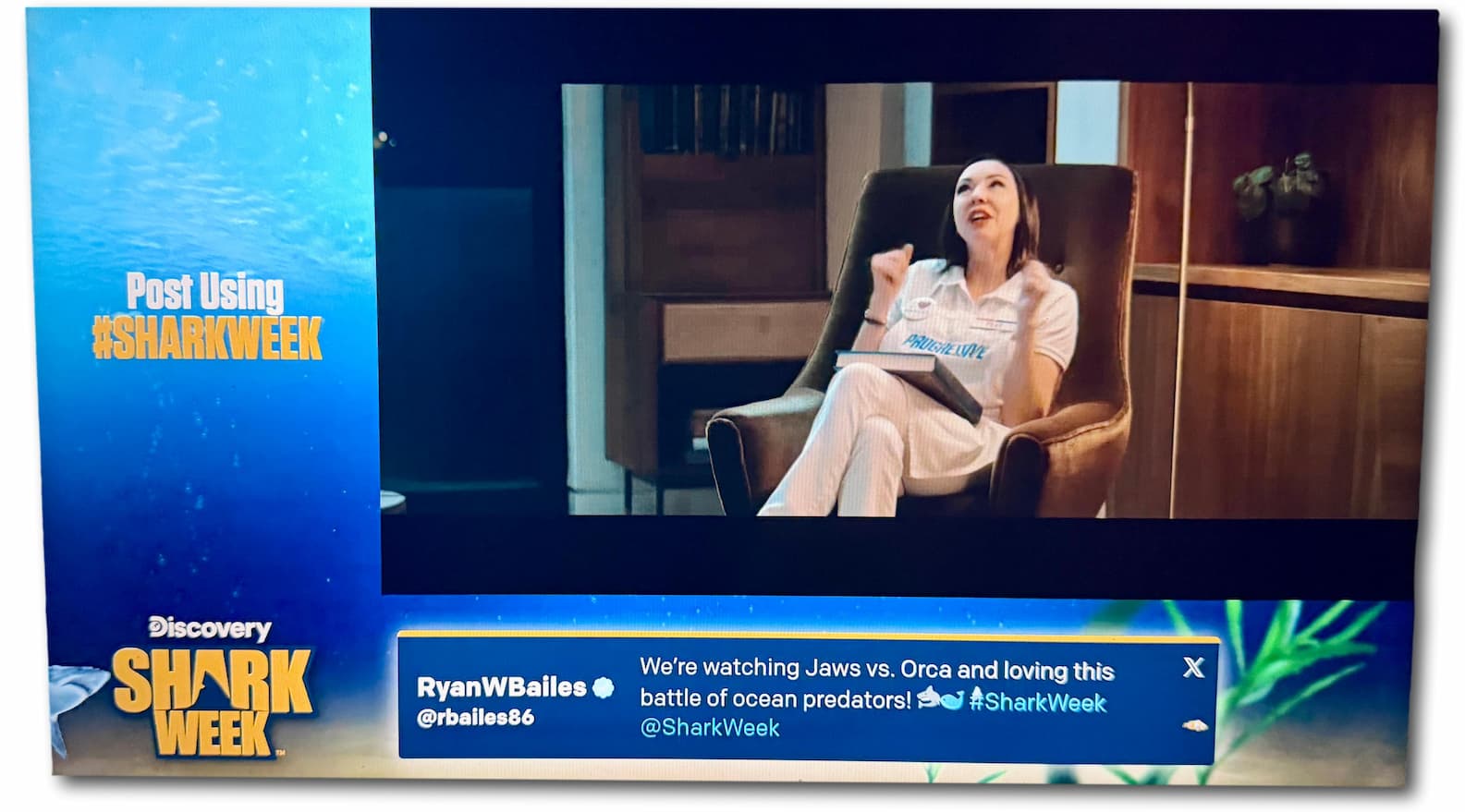
The Tweet Really Did Make It Onto Shark Week
The photograph above shows the tweet as it appeared during the broadcast. My name, X handle, message, the #SharkWeek hashtag, and Discovery’s Shark Week branding are all visible on the screen.
That photograph matters because it documents the appearance as it happened.
We are not relying on a memory, a secondhand account, or somebody saying they happened to see it. The evidence is right there on the television.
Publishing the photograph here also gives the moment a permanent home online. This page connects the image with my name, social handle, the exact wording of the tweet, the program that was airing, and the date of the appearance.
A television moment may last only a few seconds. A webpage can stay up and still be found months or years later.
What the Photograph Proves
The photograph documents one clear fact: a tweet from my @rbailes86 account appeared during Discovery’s July 28, 2026, broadcast of Jaws vs. Orca.
It does not show that Discovery endorsed me, recommended Bailes + Zindler, reviewed our work, or formed a partnership with our agency.
It also does not prove that the appearance improved our rankings, increased website traffic, or made Bailes + Zindler more visible in AI search.
Those are separate questions.
The only responsible way to answer them is to record what happened before the broadcast, measure what happens afterward, and report the SEO results without stretching the story beyond the evidence.
For now, it was a memorable television appearance. Whether it becomes an SEO result remains to be seen.
The tweet appeared on television. That is already a pretty good story. There is no reason to turn it into something it was not.
Why Publish a Follow-Up Article?
Search engines cannot index the television in my living room.
Without a webpage, the appearance would exist mainly as a short-lived broadcast moment and a photograph on my phone. Publishing this follow-up creates a lasting, searchable SEO record connecting the image with my name, social handle, the program, the date, and the original article.
It also puts several useful pieces of information in one place:
- The original photograph
- My name and social handle
- The exact wording of the tweet
- The Shark Week program where it appeared
- The date of the broadcast
- The original article about Shark Week, SEO, and AI search
- Any measurable results that follow
None of that guarantees rankings, traffic, backlinks, mentions, or AI citations.
It simply gives people, search engines, journalists, and AI platforms an accurate source they can find later.
That is a much more realistic SEO goal than pretending a few seconds on television somehow flipped an SEO switch.
What We Are Doing With the Photograph
We are keeping the follow-up straightforward.
First, the photograph is being published prominently on this page with a descriptive filename, useful alternative text, and enough context to explain exactly what it shows.
Second, the original Shark Week SEO article will be updated with a note confirming that the tweet appeared, along with a link to this follow-up.
Third, we will share the story through channels where we are already active, including X, LinkedIn, Facebook, and our Google Business Profile.
Then we will give it some time and review the first results in about 30 days.
There will be no daily spreadsheet, complicated attribution model, or twelve-tab dashboard.
Shark Week is supposed to be fun.
What We Will Measure
After about 30 days, we will review four main areas:
- Traffic to the original article and this follow-up
- Search impressions involving Ryan Bailes, Bailes + Zindler, and Shark Week
- New backlinks, referring domains, and online mentions
- Business inquiries connected to the appearance
We will use Google Search Console, website analytics, backlink data, and a small number of manual searches.
The main numbers will include:
- Total clicks
- Total search impressions
- Click-through rate
- Queries related to my name and the agency
- Pageviews for both Shark Week articles
- New referring domains
- New backlinks
- Relevant online mentions
- Search visibility for related terms
We recorded the current numbers before beginning the test. Those baseline figures will be compared with the results at the 30-day mark.
Without a baseline, a traffic bump is just a traffic bump. With one, we have a better chance of determining whether anything meaningful changed.
The goal is not to manufacture an impressive result. It is to find out whether documenting and distributing the appearance gave the moment any measurable SEO life after television.
We Will Also Watch AI Search
The original article asked whether a television appearance could affect not only traditional SEO but also visibility in AI-generated search results.
That part is harder to measure.
AI platforms can produce different answers depending on the wording of the question, the date, the system being used, and whether live web search is involved. A single search result would not prove much.
Instead, we will periodically test a small group of consistent questions, including:
- Did Ryan Bailes appear on Shark Week?
- Whose tweet appeared during Jaws vs. Orca?
- Can appearing on Shark Week help SEO?
- What happened after Ryan Bailes’ tweet appeared on Shark Week?
- Are there examples of television exposure affecting SEO?
We will look for whether this article, my name, the @rbailes86 account, or Bailes + Zindler appears in the answers or supporting citations.
That still will not give us perfect data, but it may show whether the story is becoming easier for AI platforms to discover and connect with the right people and entities.
What Would Count as a Real SEO Result?
A real SEO result would be something that lasts after Shark Week is over.
That might include:
- More branded searches for Ryan Bailes or Bailes + Zindler
- Organic traffic to either Shark Week article
- A relevant website linking to the story
- The photograph appearing in image search
- An online mention from another publication
- A citation or accurate mention in an AI-generated answer
- A business inquiry tied to the appearance
Likes, reposts, comments, and new followers would all be welcome. They would show that people noticed the story.
They would not, by themselves, prove that the television appearance helped SEO.
The more interesting question is whether documenting the moment creates a digital asset that continues to be found after the original broadcast has faded from memory and continues to support SEO.
What Do I Expect to Happen?
Realistically, the results may be modest.
A strong result would include more branded searches, a noticeable increase in organic traffic, a relevant backlink, an accurate AI citation, or a business inquiry connected to the story.
A weaker result might be a brief rise in pageviews and social engagement with little change in search visibility.
A neutral result would mean almost nothing changes.
All three outcomes would tell us something.
If the results are strong, we will turn them into a fuller case study and share what we learned.
If the results are weak, we will look for reasonable ways to get more mileage from the story. That could include pitching it to relevant publications, mentioning it during outreach, contacting industry partners, or repurposing parts of the experiment into other content.
If the numbers barely move, we will document that too and note what it suggests for future efforts.
Not every television appearance becomes a marketing win. Sometimes attention disappears almost as quickly as it arrives.
Pretending otherwise would not make the case study more useful.
Why the Story Still Has Value
A brief appearance on television does not automatically create national recognition or a wave of backlinks, so it does not automatically create SEO value.
Most viewers were watching sharks and orcas. They were probably not pausing the screen to write down my name.
Still, the appearance gives us something unusual and original to document.
Nobody else has this exact photograph, this firsthand account, or the eventual data showing what happened to our website afterward.
That originality matters.
If the article earns traffic, links, mentions, or search visibility, we will have a small real-world SEO example of how temporary media attention can be turned into a lasting digital asset.
If almost nothing happens, that result matters too.
It would support the argument from the original article: television can create attention, but attention does not automatically become SEO value.
For marketers dealing with modest results after a media appearance, the better move may be to keep working the story.
Turn it into a case study. Preserve the evidence. Pitch it where it makes sense. Mention it during outreach when it provides a natural reason to begin a conversation. Connect it with other useful content instead of expecting the appearance to carry the entire strategy.
The appearance itself may not create lasting search value.
Sometimes the value comes from what you build around it afterward.
The Experiment Is Officially Underway
The original article argued that appearing on television would not be the SEO strategy.
The strategy would be everything that came next: saving the evidence, publishing accurate context, connecting the relevant pages, sharing the story, and measuring what happened afterward.
That is what this follow-up is doing.
After the 30-day mark, we will return with any findings worth sharing. We will review traffic, branded searches, backlinks, mentions, AI-search visibility, and business inquiries.
If something continues developing beyond the first month, we will keep tracking it.
Until then, the conclusion is simple:
The tweet made it onto Shark Week. Now we get to see whether documenting the moment gives it any life after television.
Whatever the analytics eventually say, seeing my post appear during Shark Week was still pretty dang cool.