
Broadway Energy Land Services Redesign
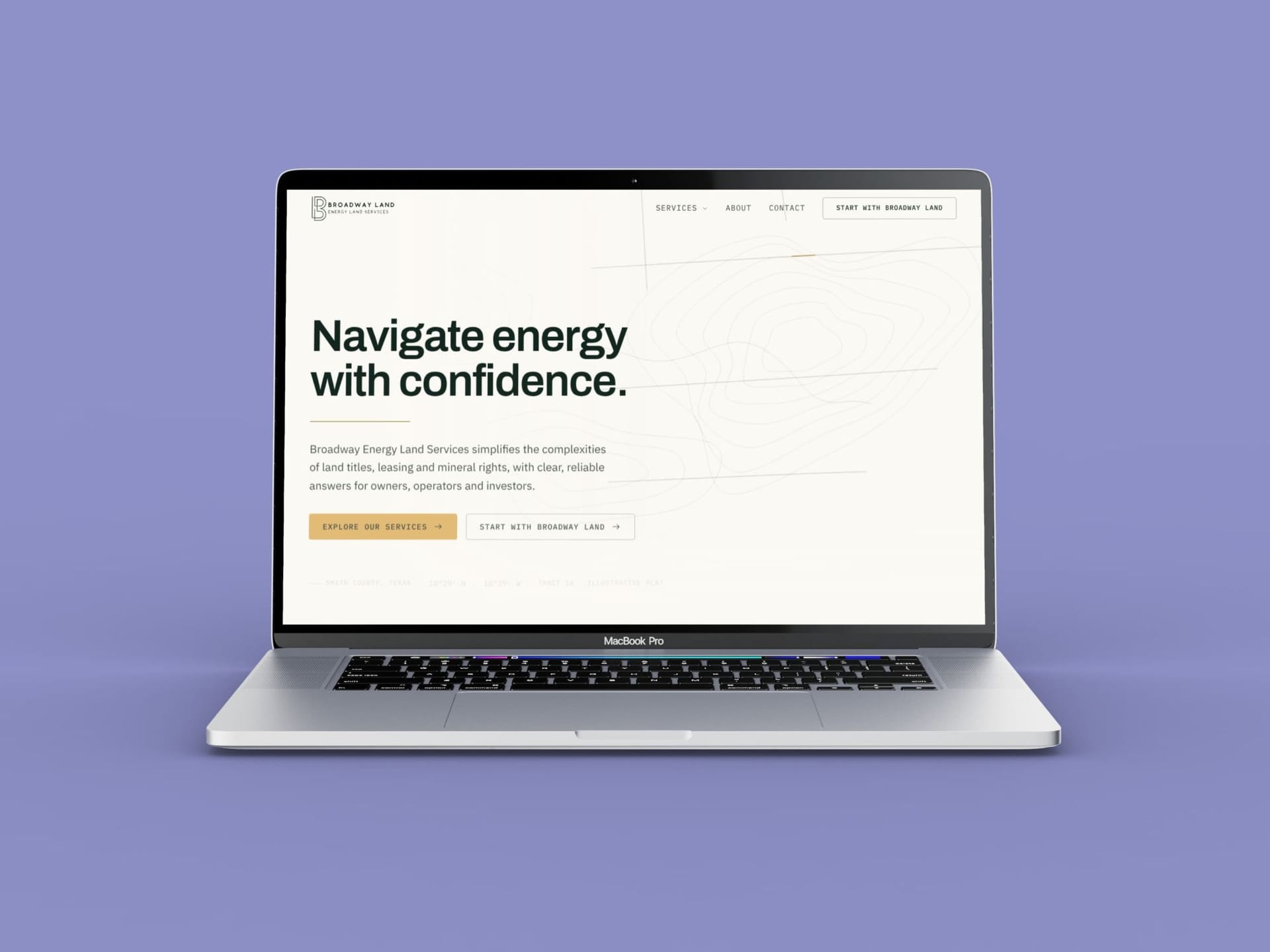
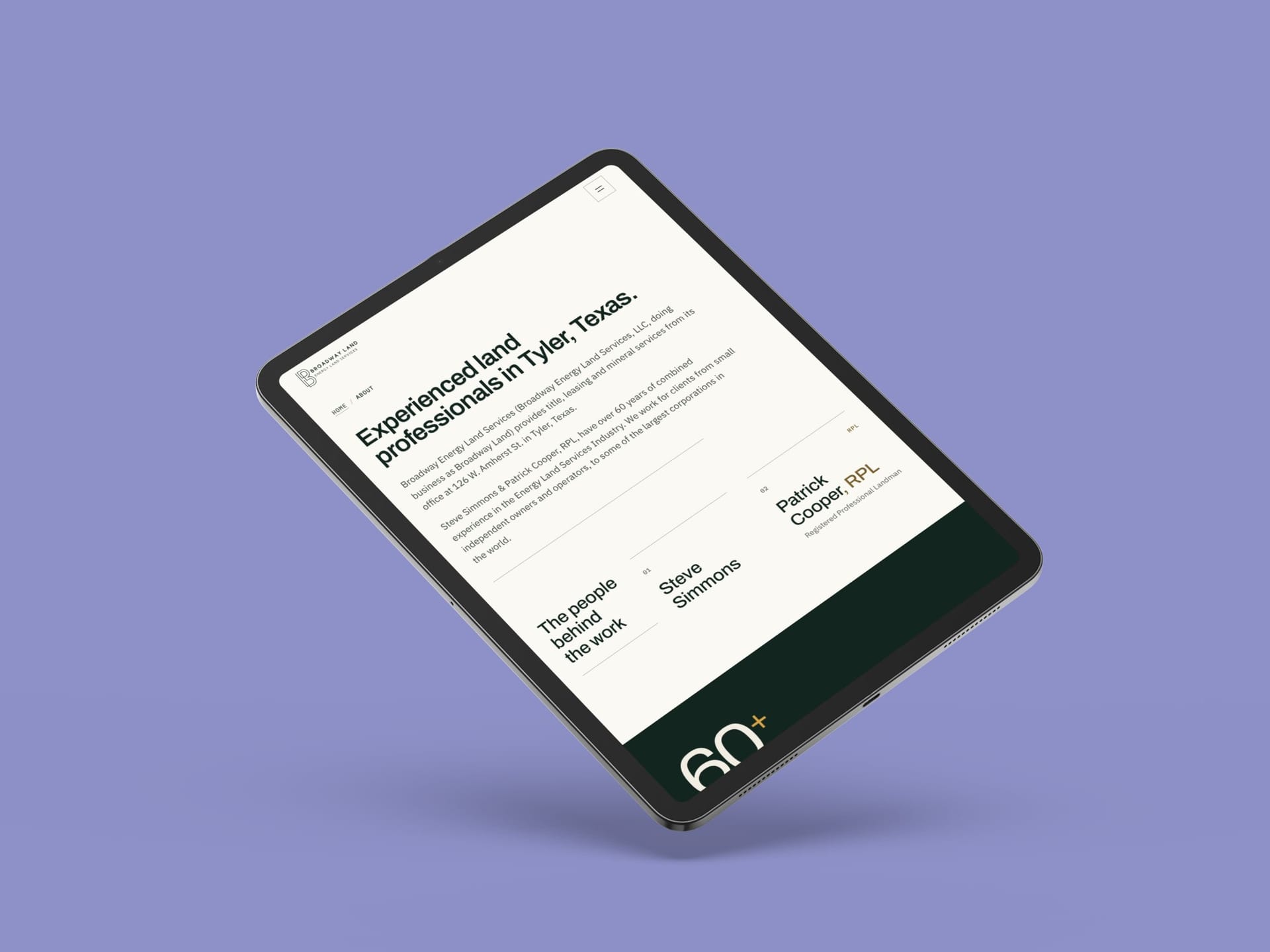
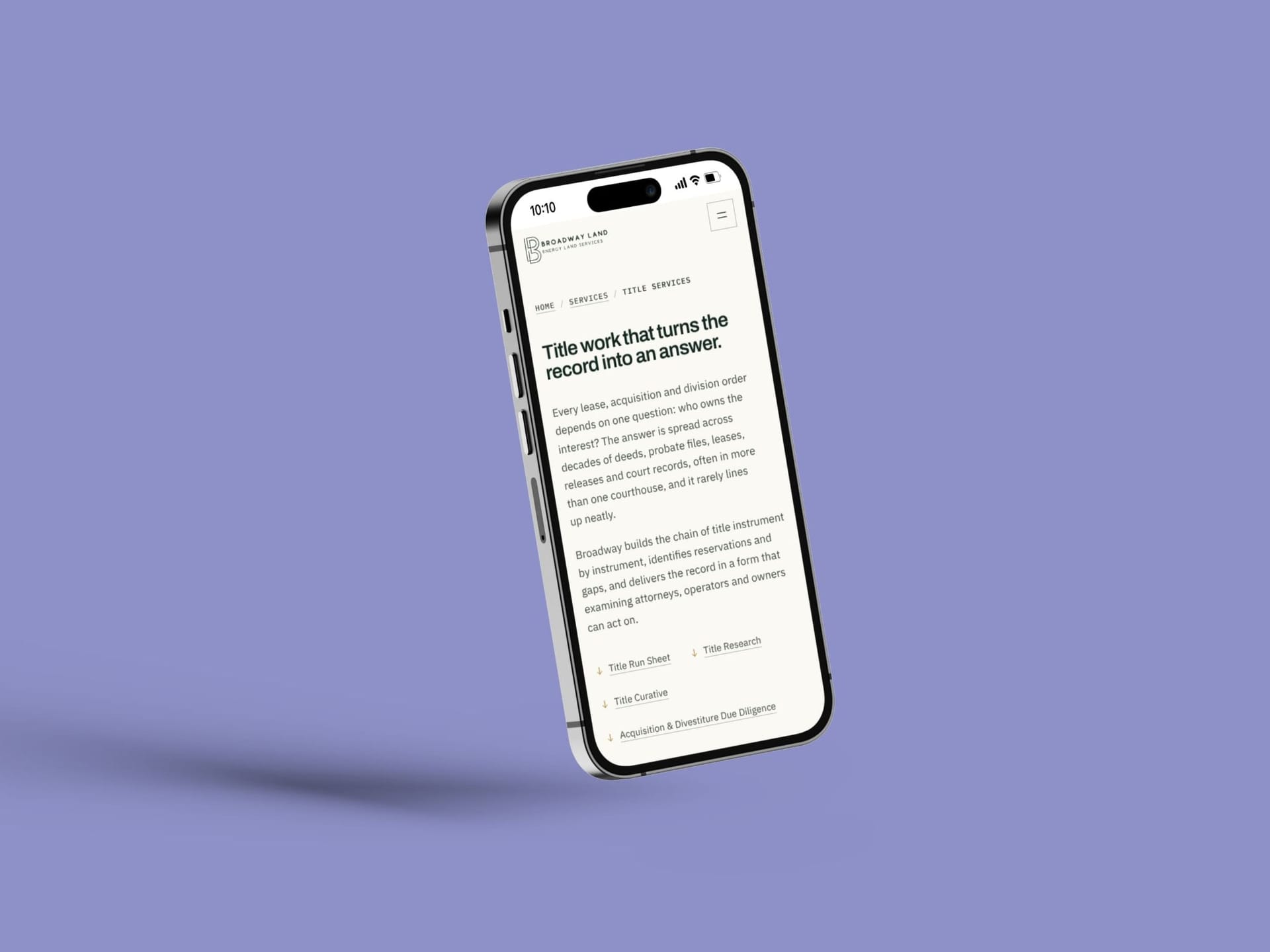
Bailes + Zindler rebuilt Broadway Energy Land Services' four-page Squarespace site into a custom, interactive website built for clarity, search, and growth.
Broadway Energy Land Services helps energy companies, owners, and operators navigate title research, leasing, mineral interests, and related land work across Texas.
The expertise was already there. The website wasn’t showing it.
Bailes + Zindler replaced Broadway Land’s four-page Squarespace site with a custom website built around the work land professionals actually do. Instead of relying on generic oilfield imagery and a short list of services, the new site focuses on plats, title chains, leasehold ownership, mineral interests, wellbores, and the records that connect it all.
Website Design + Development · Content Strategy · SEO · AI Search Optimization · Accessibility
Project at a Glance
The original four-page website became an 11-page custom site with ten land services explained in detail, a glossary covering 30 oil and gas land terms, and more than 80 automated browser and accessibility tests that help keep the site reliable.
Just as important, the new website better represents the more than 60 years of combined industry experience behind Broadway Energy Land Services.
Those 80-plus tests cover what matters, including accessibility, keyboard navigation, mobile behavior, redirects, animation behavior, and what happens when JavaScript is disabled.
The Challenge
Broadway Land knew the work. The website didn’t show it well.
Broadway Land’s previous website had four primary pages and listed its ten services mostly by name. Visitors could see what the company offered, but it didn’t explain what those services involved, how they related to one another, or why Broadway Land’s experience mattered.
The website’s visuals had the same problem. Stock photographs of pumpjacks, cattle, handshakes, and generic oilfield scenes made Broadway Land look like many other energy companies.
But land work isn’t really about dramatic pictures of drilling rigs. It’s about ownership, boundaries, leases, records, surveys, interests, and details. That distinction became the starting point for the redesign.
The Strategy
Show the work instead of decorating around it.
We started with a simple idea: if Broadway Land is good at making sense of complicated land and energy matters, the website should help people make sense of them too.
That meant moving away from the usual oil-and-gas website playbook. Instead of building the design around stock photography, we took cues from the documents and information Broadway Land works with every day: survey plats, property boundaries, title records, leasehold interests, mineral ownership, and well geometry.
Those ideas became part of the website’s visual language. A thin, survey-inspired line moves through the design and changes meaning depending on where you are. In one place it resembles a property boundary. Elsewhere it becomes a title connection, wellbore, horizontal lateral, or pipeline.
The color palette changed too. We moved away from the darker petroleum-industry look to a lighter paper-and-ink aesthetic, using survey-inspired cream and deep green.
The result still feels appropriate for an energy company, but it looks much more like Broadway Land’s actual work.
Making Land Services Visual
Some land services are difficult to explain with a paragraph and a photograph. So for three of Broadway Land’s core service areas, we built interactive explanations that show how the work fits together and what each service helps visitors understand.
Title Services
The Title Services page uses a fictional property history to demonstrate how a chain of title develops over time. Visitors can follow the property from a 1948 deed through mineral reservations, ownership changes, an heirship gap, and ultimately to a present-day mineral interest.
On larger screens, the ownership graph stays connected to the explanation as visitors move through the page. On phones and smaller screens, that same information becomes a simpler vertical timeline.
Leasing Services
Rather than simply defining lease acquisition and lease take-off, the Leasing Services page shows the process and what it helps visitors understand.
Five adjoining tracts gradually become a coordinated leasehold. Visitors can review acreage, owners, tract status, and progress toward a proposed horizontal lateral. It gives someone who may not deal with land work every day a clearer picture of how leasing works.
Mineral Services
The Mineral Services page takes a different approach. An interactive geological cross-section illustrates the relationship between the surface estate, mineral estate, producing formation, wellbore, royalty interest, and working interest, helping visitors see how those layers relate.
Visitors can use keyboard-accessible controls to explore the layers independently, with explanations and examples providing context.
None of these examples represents an actual Broadway Land tract, client, or transaction. We created them specifically for the website, giving Broadway Land a way to demonstrate its expertise without exposing private client information.
From a Service List to an Information Architecture
We gave every major service somewhere to live.
The old Broadway Land website grouped ten service names into three basic categories. The new site keeps that overall organization, but Title, Leasing, and Mineral now have dedicated sections where individual services can be explained in detail, making it much clearer what each one covers.
That change may sound simple, but it makes a big difference. Someone looking for lease acquisition, title curative work, mineral ownership research, or another specific service no longer has to guess what Broadway Land means from a label. They can better understand what each service involves and what it is meant to accomplish.
We also created an Oil & Gas Land Terms resource with 30 plain-English definitions. Each term has its own permanent link, related terminology, additional context where it makes sense, and a connection back to the Broadway Land service it relates to, so visitors can see how the terms support the work.
Instead of a website made up of a few disconnected pages, Broadway Land now has a growing body of information built around what the company actually knows.
Built for Search Engines and Answer Engines
Clear to people. Structured for machines.
A website can look impressive and still be surprisingly difficult for a search engine or AI system to understand.
We made sure Broadway Land’s important information isn’t locked inside animations, graphics, or JavaScript. The core service explanations, company information, terminology, and other important content remain real HTML that can be read even when the visual layer is stripped away.
Behind that content is a much more intentional search structure, including individual page titles and descriptions, logical headings, breadcrumbs, XML and HTML sitemaps, internal linking, robots.txt, IndexNow submission, and a supplementary llms.txt file.
We also added structured data for Broadway Land itself, its principals, all ten services, and the land terminology resource. Rather than leaving those relationships for Google, ChatGPT, or another system to figure out on its own, the site gives them clearer information about who Broadway Land is, what it does, who is involved, and what the company knows.
That’s an important part of how we approach AI Search Optimization at Bailes + Zindler. It starts with making a company and its expertise exceptionally clear, then giving search engines and AI systems enough structure to understand the relationships between that information and the services it supports.
Accuracy Matters When the Subject Matter Does
We weren’t going to manufacture expertise just to make the website sound impressive.
Broadway Land’s previous website had very little explanatory content, so we had to develop much of the new educational copy from scratch. But with land work, simply writing something that sounds correct isn’t good enough.
Words can carry legal and financial implications. During the content process, we paid close attention to statements that could say more than the underlying concept supported.
For example, the site distinguishes evidence provided by an affidavit of heirship from making an absolute claim that title has been “verified.” It explains the role of the executive right in lease acquisition and separates a mineral value estimate from circumstances where a formal appraisal may be appropriate.
In other words, we weren’t filling pages with SEO copy just because a keyword needed somewhere to go. The goal was to make complicated information useful, so people could better understand the services without pretending the website could replace the professional judgment the work itself requires.
A Website Built as a System
Changing the design shouldn’t mean rebuilding the website.
Behind the finished site is a reusable design system, not eleven pages styled independently.
Shared design tokens control colors, typography, spacing, layouts, and other design decisions. Those tokens feed reusable components, and those components build the pages. So if something changes later, we can update the system instead of hunting through page after page to fix the same thing repeatedly.
We also created components specifically for Broadway Land’s subject matter, including tracts, ownership nodes, title records, lease status, interest values, document references, survey markers, and plat boundaries.
Under the hood, the site uses Next.js 16, React 19, TypeScript, Design Tokens, Storybook, and Vercel.
That technology matters, but the more important point is what it gives Broadway Land: a website that can continue growing without becoming harder to maintain every time something new is added.
Accessibility Was Part of the Build
Not something we checked at the end.
We considered accessibility throughout development rather than treating it as a final checklist before launch.
We tested the website across multiple desktop and mobile widths, using keyboard navigation, reduced-motion preferences, and JavaScript-disabled browsing. Automated testing also looks for accessibility problems after animations run, checks heading structure, catches horizontal overflow, and verifies that important interactive elements remain usable from a keyboard.
We’re also careful about the way we describe that work. Rather than making a blanket claim that the website is “WCAG compliant,” we can say something much more specific and defensible: automated WCAG 2.2 AA accessibility scans currently report no violations across the tested pages, alongside manual keyboard, responsive, and reduced-motion testing.
The Result
A website that looks more like Broadway Land’s expertise and actually shows it.
The new Broadway Energy Land Services website isn’t a four-page brochure with a list of services anymore.
It explains complicated work in a way prospective clients can understand. It gives people something useful before they ever pick up the phone. It gives search engines much clearer information about the services Broadway Land provides, and it gives AI systems structured facts instead of making them piece together the company from a handful of vague pages.
More importantly, the website finally gives Broadway Land room to grow. New insights, team information, project experience, terminology, service information, and other resources can now be added to an existing system instead of forcing the company to rethink the website every time something changes.
The new site launched September 29, 2026, with Broadway Land retaining ownership of its codebase and a deployment workflow built around GitHub and Vercel.
Your company probably knows more than your website shows.
That may be the biggest takeaway from the Broadway Land project.
Years of experience don’t automatically translate into a strong website. A company can be very good at what it does and still have a digital presence that barely scratches the surface. Sometimes the problem isn’t what a business knows. It’s that the website never gives anyone a chance to see it.
Bailes + Zindler builds websites that turn real expertise into something customers, search engines, and AI systems can understand.