Outgrown WordPress? Rebuild Your Website for the Modern Web.

Your business has evolved. Your website technology should keep up.

Many businesses start on WordPress and eventually outgrow it — stacking plugins, fighting a page builder, and carrying a growing maintenance and security burden just to keep the site running. Bailes + Zindler rebuilds those websites on modern frameworks such as Astro, Next.js, Nuxt, Vue, and React, so your site is faster, more flexible, and easier to maintain going forward.

A move off WordPress does not mean starting from zero. We preserve what is worth keeping — your domain, your branding, the content and URLs that matter, and the SEO equity you have already earned — while improving the design, performance, and architecture underneath.
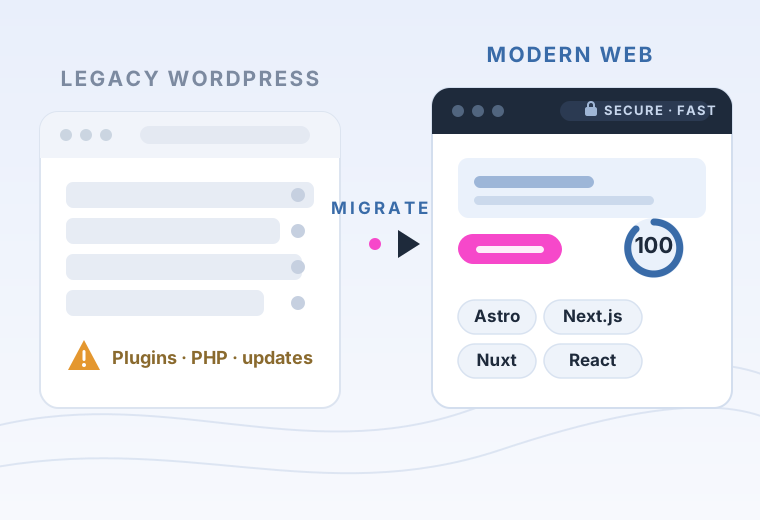
A cluttered legacy WordPress site migrating to a fast, clean modern-framework website built with Astro, Next.js, Nuxt, and React by Bailes + Zindler.

Website Redesigns · WordPress Migration · SEO Preservation · Modern Development · Texas-Based

Your Website Shouldn't Be Limited by the Technology It Was Built On

WordPress has powered a huge share of the web for years, and for good reason — it made publishing accessible and gave businesses a quick way to get online. Many successful websites started exactly that way, and there is nothing wrong with that beginning.

The challenge comes later. As a business grows, its website often needs to do more than the original setup was designed for. Plugins pile up, page builders start dictating the design, performance slips, and keeping everything patched becomes a recurring chore. At that point, the technology the site was built on can quietly hold the business back.

Moving to a modern framework is not about chasing trends. It is about building the website around your business and its goals — rather than forcing your business to work within the limits of an aging stack.

Signs You've Outgrown Your WordPress Website

A WordPress site rarely fails all at once. More often, a few familiar frustrations add up until the platform is clearly working against you.

You have too many plugins

Over time, WordPress sites tend to accumulate plugins to add features the core platform never provided. Each one is additional code to update, secure, and keep compatible. When a website depends on a long list of third-party plugins just to function, routine maintenance becomes risky and updates can break the site.

Your page builder limits your design

Page builders make it easy to launch a site quickly, but many businesses eventually hit their ceiling. Layouts become hard to change, templates feel generic, and the markup they generate can work against performance and search. The design starts dictating the business instead of the other way around.

Your website is not performing

Slow load times, heavy pages, and bloated code affect both the visitor experience and search performance. When plugins, themes, and builders stack on top of each other, the result is often a site that feels sluggish on real devices and real connections.

You have security and maintenance concerns

WordPress is the most targeted website platform in the world, largely because of its scale and its plugin ecosystem. Keeping core, themes, and plugins patched is an ongoing responsibility, and a single outdated component can expose the entire site.

Your website is not generating enough business

A website should help the right prospective customer understand what you do and take the next step. If your current site looks dated, buries your best services, or simply does not turn visitors into inquiries, the underlying technology may be holding back the business goals.

You need more flexibility

As businesses grow, they often need custom functionality, integrations, and experiences that do not fit neatly into an off-the-shelf theme. When every new idea requires another plugin or a workaround, it may be time for an architecture built around your requirements.

A Modern Website Without the Traditional WordPress Foundation

Instead of building on WordPress, we build on modern frameworks chosen to fit the project. Each has its strengths, and the right one depends on what the website needs to do.

Astro

Astro is a modern framework built for fast, content-focused websites. It ships minimal JavaScript by default, which helps with performance and search, and it is a strong fit for marketing sites, service businesses, and content-driven websites that need to load quickly and rank well.

Next.js

Next.js is a widely adopted React framework for building fast, scalable, and dynamic websites and web applications. It supports server-side rendering and static generation, making it a flexible choice for sites that combine marketing pages with more interactive, application-like functionality.

Nuxt

Nuxt is a framework built on Vue for creating fast, modern websites and applications. It offers flexible rendering options and a productive developer experience, and it is a good fit for teams and projects aligned with the Vue ecosystem.

React

React is a foundational library for building interactive user interfaces, and it underpins many modern websites and applications. For projects that require rich interactivity or custom front-end functionality, React provides a proven foundation we can build on directly or through a framework like Next.js.

Vue

Vue is an approachable, widely adopted JavaScript framework for building interactive interfaces, from small enhancements to full applications. It is the foundation Nuxt is built on, and it is a good fit when a project benefits from Vue’s component model, gentle learning curve, and mature ecosystem.

The right technology for the right project

There is no single best framework for every website. We evaluate your goals, content, functionality, integrations, and how the site needs to grow, then recommend the architecture that fits — rather than forcing every project into the same tool. The result is a website built around your business, not around the limitations of a platform.

What Happens to Your Existing WordPress Website?

Rebuilding on a modern framework does not mean throwing away everything you already have. A migration is a chance to keep what works and improve what doesn’t.

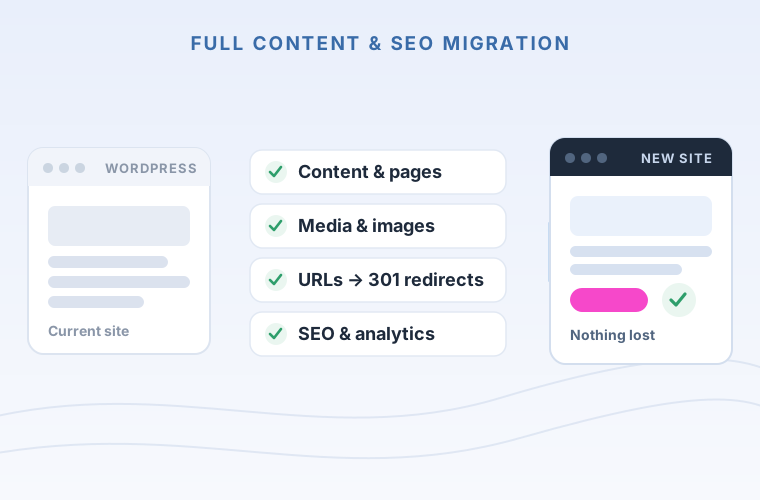
Migrating a WordPress site to a modern framework: content and pages, media and images, URLs with 301 redirects, and SEO and analytics all carried across to the new site with nothing lost.

What we can preserve

  • your domain name
  • your branding and visual identity
  • content worth keeping
  • important URL structure
  • existing SEO foundations
  • analytics and tracking
  • business-critical integrations

We identify what is worth keeping early, so the move to a modern framework carries your business forward instead of resetting it.

Protecting Your SEO During a WordPress Migration

An established website can have years of search equity behind it. Pages may already rank, other sites may link to them, and Google may already understand how your services, content, and locations relate. Before changing an established website, we evaluate:

  • current search visibility
  • pages receiving organic traffic
  • key URLs and rankings
  • existing content worth keeping
  • metadata
  • internal links
  • backlinks
  • redirects
  • technical SEO
  • Search Console data where available

A platform change does not automatically cost you rankings, but a careless migration can. We cannot guarantee rankings will never move, but protecting the search equity you have already earned — and avoiding the preventable mistakes — is a core part of the rebuild.

Explore Our SEO Services

What About Website Security?

WordPress is the most targeted website platform in the world, in large part because of its scale and its vast plugin ecosystem. Every plugin and theme is additional code that has to be trusted, updated, and kept compatible — and a single outdated or vulnerable component can put the whole site at risk.

We have written about active threats targeting WordPress sites, including the PHP2Shell advisory. Rebuilding on a modern framework reduces reliance on a long list of third-party plugins and removes much of the public-facing attack surface that comes with a typical plugin-heavy WordPress install.

Can You Still Update Your Website Without WordPress?

Yes. Leaving WordPress as your public website platform does not mean giving up the ability to edit your own content. When self-service editing is part of the project, we recommend a content management workflow that fits your team — without the overhead of a full WordPress install behind the live site:

  • a content management workflow matched to your team
  • editable pages and content sections
  • blog and article publishing
  • image and media updates
  • metadata and SEO fields
  • structured, predictable content models

The right editing setup depends on who updates the site and how often. We define that during planning so your team can keep the website current with confidence.

More Than a WordPress Conversion. A Better Website for Your Business.

Moving off WordPress is an opportunity, not just a technical swap. A rebuild lets us improve the parts of the website that actually affect the business:

Custom Website Design

A design built around your brand, your services, and the people you want to reach — not forced into a generic theme or page-builder template.

Performance-Focused Development

Modern frameworks let us ship lean, fast pages, which supports both the visitor experience and search performance on real devices and real connections.

SEO

We carry over the search equity worth keeping and build the new site on a clean, search-friendly foundation of structure, metadata, internal linking, and technical SEO.

AI Search Readiness

We structure services, audiences, locations, and expertise so both traditional and AI-assisted search systems can understand and evaluate the business.

Conversion-Focused Experiences

We design clear paths to the next step — inquiries, calls, scheduling, and other meaningful actions — so traffic has a chance to become real business.

Long-Term Maintainability

A modern architecture reduces reliance on a long list of plugins, which lowers the ongoing maintenance and security burden over the life of the site.

Our WordPress Website Redesign Process

  1. 01

    Review Your Existing Website

    We review your current WordPress site, its content, features, plugins, integrations, search footprint, and technical considerations. This is where we identify what is worth keeping and what should be improved, replaced, or retired.

  2. 02

    Plan the New Website

    We determine the right architecture and the right framework for your project, then plan how services, audiences, content, and conversion paths should be organized. The plan comes from your business and its goals, not a generic template.

  3. 03

    Design and Develop

    We develop the design system, page structure, and content, and build the responsive website on a modern framework. Stakeholders can review during development so the new site reflects the business accurately.

  4. 04

    Migrate Content and Prepare for Launch

    We migrate approved content, implement technical SEO, prepare redirects where necessary, reconnect important integrations, configure tracking, and complete launch QA so nothing important is lost in the move.

  5. 05

    Launch, Monitor, and Support

    After launch, we monitor the site and its search performance and support it going forward. A website is infrastructure — the strongest sites keep improving after they go live.

Is Moving Away From WordPress Right for Your Business?

Not every WordPress site needs replacing. Plenty of businesses are well served by a properly built and maintained WordPress website, and we will tell you if that is the case. The question is whether the platform is helping your business or quietly working against it.

If your current site is slow, hard to update, plugin-dependent, or simply no longer reflects the business, a modern rebuild may be the better path. Bailes + Zindler has offices in Tyler and Houston and works with businesses throughout Texas and beyond. We are happy to review your existing WordPress website and talk honestly about whether a move makes sense.

WordPress Website Redesign FAQs

Can you redesign my WordPress website without using WordPress?

Yes. We can rebuild an existing WordPress website using another architecture, such as Astro, Next.js, or Nuxt, while migrating approved content and functionality. The appropriate approach depends on the website’s requirements.

Will my new website still need PHP?

Not necessarily. Many websites can be rebuilt and hosted without PHP in their public-facing architecture. Some third-party services or integrations may still depend on PHP independently.

Will I lose my Google rankings if I leave WordPress?

A platform migration does not automatically mean losing your rankings. However, redesigns and migrations can affect search performance. We evaluate your current search visibility, key URLs, content, redirects, and technical SEO to minimize avoidable disruption.

Can I keep my existing domain name?

Yes. In most cases, your existing domain can continue pointing to the new website once it’s ready to launch.

Will I be able to edit my website myself?

Yes, if the project requirements include self-service content editing. We can recommend a content management workflow that fits your team’s needs without requiring WordPress as the public website platform.

Can you migrate my WordPress blog posts?

Yes. We can evaluate and migrate existing blog content as part of the rebuild. We review URLs, images, metadata, internal links, and other important details before moving the content.

What if my WordPress website has custom features or plugins?

We review each important feature and determine how it should work on the new website. We can replace some features with simpler integrations, while others may require custom development. We evaluate complex functionality before finalizing a migration approach.

Do you work with businesses outside Tyler?

Yes. Bailes + Zindler has offices in Tyler and Houston and works with businesses throughout Texas and other markets.

Next step

Ready to Move Beyond WordPress?

Keep what works. Improve what doesn’t. Build for what’s next. If your WordPress site has become slow, plugin-heavy, hard to maintain, or no longer reflects your business, we can review the current site and the search footprint and talk through what a modern rebuild would involve.

What can we do for you?

Get a quote
Get a quote